Context
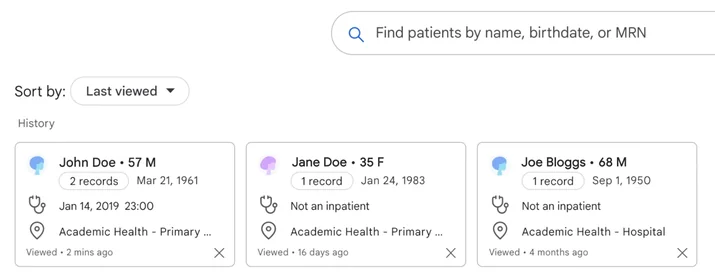
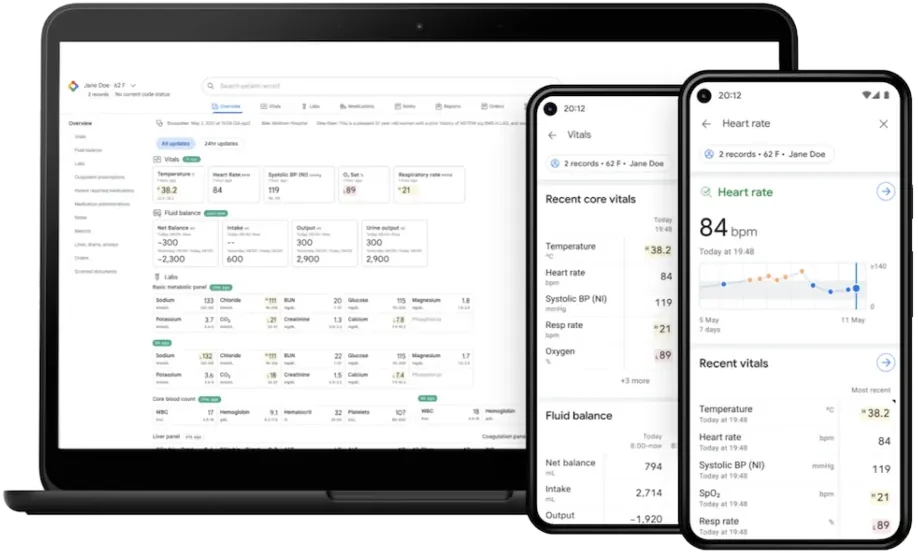
From 2019 to 2023 I led Care Studio at Google Health, with a team of more than 35 people across several countries. Care Studio sat on top of the systems a health system already ran. It brought the record together, harmonised it (the same lab reported in different units, for example), and let doctors and nurses search it in clinical shorthand or everyday language.
On that foundation we shipped clinician-facing AI: record summarisation, a conditions view that summarised a patient’s problems with the evidence alongside, and NLP-derived risk insights.
More on Care Studio: Our Care Studio pilot is expanding to more clinicians (Google), Google Health’s Care Studio (Health Information Alliance) and Google Care Studio: the power of search for medicine (Healthcare Digital).
What the real problem was
Three things decided whether Care Studio would be used or ignored.
Trust. A clinician is accountable for what they act on. A summary without its source is a claim they cannot check, so every result had to link back to the note, lab or letter it came from.
Messy data. Records differ between institutions in format, coding and units. Scaling meant absorbing that variation, not waiting for a clean record that would never arrive.
Outcomes over output. The measure was time saved and better decisions at the point of care, not how impressive a summary looked in a demo.
What happened
Proving it in hospitals: We started with a pilot at Ascension in Nashville and Jacksonville, expanded to more physicians and nurses, and added Beth Israel Deaconess Medical Center in Boston. We then launched in the UK.
Moving into primary care: The defining decision was shifting our focus to primary care. Working with Google Health leadership, I built the business case, pitch and roadmap to bring AI insights and summarisation into preventative and primary care, particularly in the US, where the trend was heading and the opportunity for impact was larger. Desert Oasis Healthcare became our first outpatient partner in 2022.
Outliving the product: Care Studio’s search and summarisation capabilities were folded into Google Cloud’s Vertex AI Search for Healthcare, alongside the Healthcare API and Healthcare Data Engine, and reached general availability for cloud customers in October 2024.
Why it reads differently now
In September 2026, OpenAI and Epic announced an integration that lets clinicians query the record through ChatGPT. It is read-only, limited to organisations under a business associate agreement, and piloting at named health systems. The shape of it, down to the rule that the assistant reads the chart but never writes to it, is the shape we were building in Care Studio several years earlier.